
How Neighbours Save Money Together
Harry Hobson unpacks the different ways that we see neighbours saving money through co-operation. The acute Cost of Living pressure for lower-income households makes this salient and urgent: The Joseph Rowntree Foundation’s latest Cost of Living Tracker estimates that 7.4 million low-income UK households were unable to afford at least one essential item during the previous six months. Of course, truly alleviating this pressure will require a deep structural shift. But our recent work in South-East London also indicates how social connection, and cooperation, can enable significant cost-saving opportunities for communities across the country.
Neighbourly Lab has been running trials and fieldwork communities across South-East London (working with Clarion to launch Neya, as part of our William Sutton Prize for Connected Communities). Through this work, we have observed the different mechanisms through which neighbours can save money through co-operation, and the latent potential of social connection to alleviate Cost of Living Pressures. We summarise these in the green boxes in the diagram below. For each mechanism we’ll show a couple of examples.
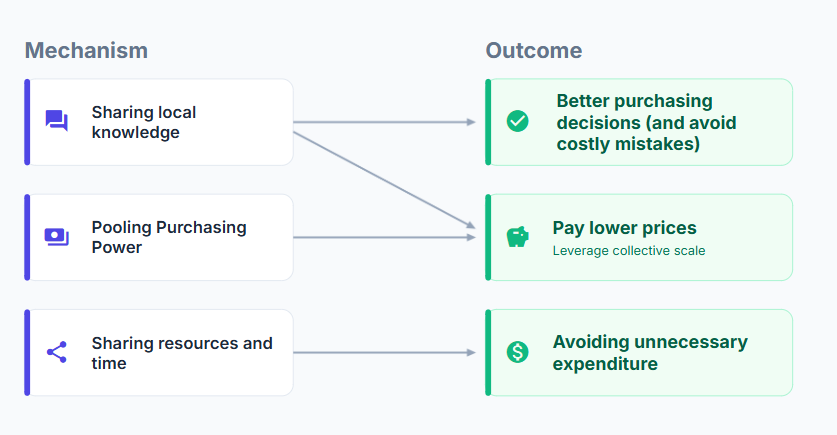
We are especially interested in how co-operation can be enabled through hyperlocal online groups, such as Neya or Whatsapp groups. These are exciting because we can see ways to build or popularise these neighbourhood-groups fairly quickly; and we can also see how they could be geared to boost trust and cohesion by deliberately including neighbours who’re different-from-one another (e.g. different ethnicity or ages or religion).
So, let’s look at some examples of the 3 mechanisms through which neighbours save money by co-operating with one another.
1. Better Purchasing Decisions, and avoiding costly risks
Neighbours asking each other for recommendations. The language we see for this often in local whatsapp groups is “Does Anyone Know… “ or “Can anyone recommend.. “
Anyone who’s in a good local Whatsapp group will see this every day. I’ve become involved in an online community group based near Orpington and the level of informal coordination, sharing of information, and swapping of tips is extraordinary. On a daily basis people request recommendations for roofers, tutors, and activities in the neighbourhood. Typically, the recommendations they receive are from local, trusted suppliers. For example:
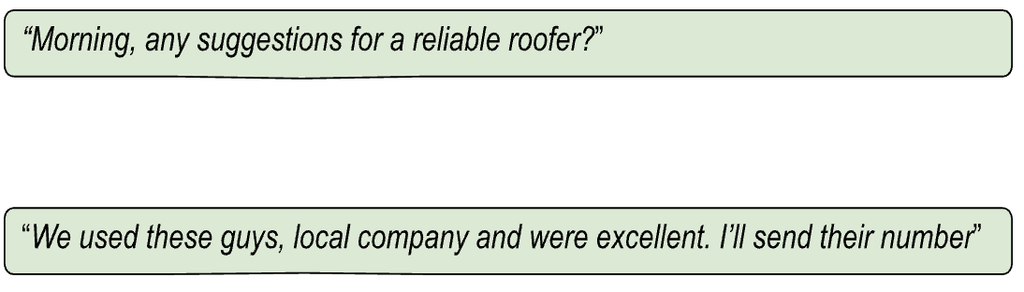
Most of this sounds pretty ordinary, but the overall economic saving of getting reliable recommendations is large for particular categories like home-repairs (roofers, builders, plumbers etc.). These are high-ticket spend where the typical householder has low domain-knowledge and no good way of discerning quality. Recent research by the Federation of Master Builders found that 37% of UK adults had hired an unreliable or unqualified builder, while 15% had lost money to a rogue builder in the previous five years, losing around £1,760 on average. They estimate dodgy builders have collectively cost us £14.3 billion in the last five years.
Strong local networks give people more collective power as consumers. By sharing knowledge about who can be trusted, communities can make opaque markets easier to navigate and reduce individuals’ exposure to unfair prices and outright scams.
2A. Paying Lower Prices by information-sharing
There are two ways in which neighbours can end up paying lower-prices.
The first is how sharing information enables neighbours to pay lower prices. Again, through our work in SE London with Clarion, we’ve seen how this generally happens very naturally. Why? Because we all love to show off and share a bargain.
A Nice example of this – one brilliant neighbour set up a group on Neya called “Scrimpers and Savers”, for neighbours on her estate to share pics of the food on discount at different local-supermarkets, esp the yellow-ticket items, often with short expiry dates. This is real-time sharing of price information that enables people to save on everyday groceries. A snippet from the group includes:
“Just been to the smaller Asda and they’ve got quite a bit of discounted food. 43p hobnobs, lots of cooking sauces and packets of nuts getting priced. Be quick!”
The level of activity and coordination we’ve seen within this group has been remarkable. And of course, as we have found in lots of Neighbourly Lab research -e.g. Revealing Social Capital– having a common hook (in this case accessing discounts) helps to bring people together, often across lines of difference. There is a sense of camaraderie in the group, which stimulates community connection and builds stronger local relationships.
2B. Paying Lower Prices by pooling purchasing power.
When neighbours combine their purchasing-power they can drive down prices.
Teaming up can enable people to buy in bulk (e.g. a 20kg bag of rice split between neighbours is twice as cheap as buying by the kilo). We also heard a nice story about how a window-cleaner is booked by one whole side of the street. So the costs of each house having their windows cleaned fell from £60 to £40.
Here are two more examples from Penge, both enabled by lively street Whatsapp groups. Sharing a carpet-cleaner, and getting Xmas trees delivered at the same time.
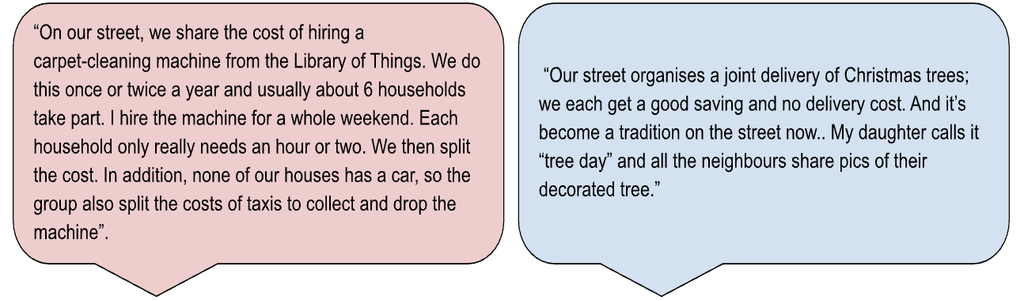
When we see this being done, it is generally in pockets and around specific savings opportunities. But in these instances, significant savings are made. The potential to support this kind of pooling, around much more of our daily expenses, is fascinating.
3. Avoiding Unnecessary Expenditure
Co-operation enables people to lend-and-borrow rather than buy. The iconic examples of these are power-drill or stepladders. And there are many stories of how the “positive friction” involved brought people together.
I’ve mentioned the Library of Things already but apps like Freecyle, Olio, and Freegle are all standing examples of our capacity and desire to cooperate around lending, borrowing, and passing on no longer needed items to neighbours.
The challenge we find, with so many of these opportunities, is that people either don’t know about them or they face a behavioural barrier to get involved. Often, the forums that enable this kind of cooperation lack the resources to do widespread digital marketing in the same way as commercial organisations. And in some cases, they would prefer to stay this way – operating in a quiet and trusted pocket of cooperation that feels truly local. These are all interesting thoughts to grapple with. But what we know for sure from our work is that social connection and cooperation is a highly effective tool for enabling cost saving opportunities.
And as well as physical assets, there’s services. We heard many examples of how co-operation enables services to be provided that prevent the need for spend. Babysitting-circles, where parents take it in turn to babysit (unpaid) to enable neighbours to have a night-out. Or the story we heard in Beckenham about how a neighbour in a tower-block (who had more DIY proficiency and recent experience of the same problem) helped his upstairs-neighbour to quickly fix a blockage that saved her calling an out-of-hours plumber.
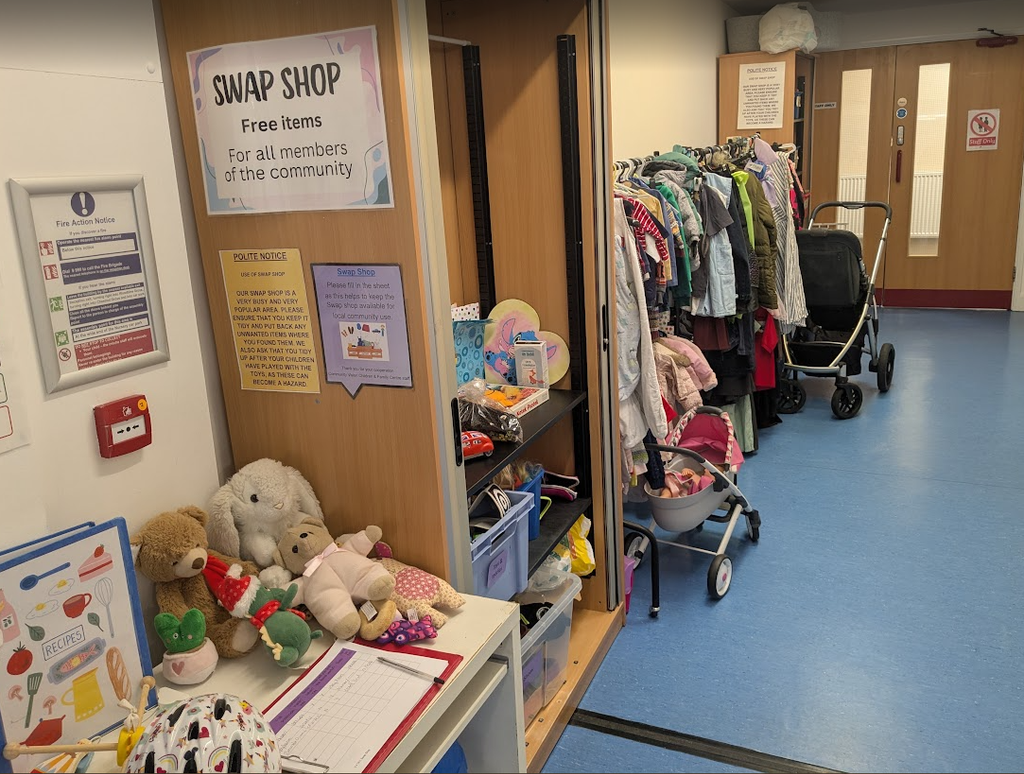
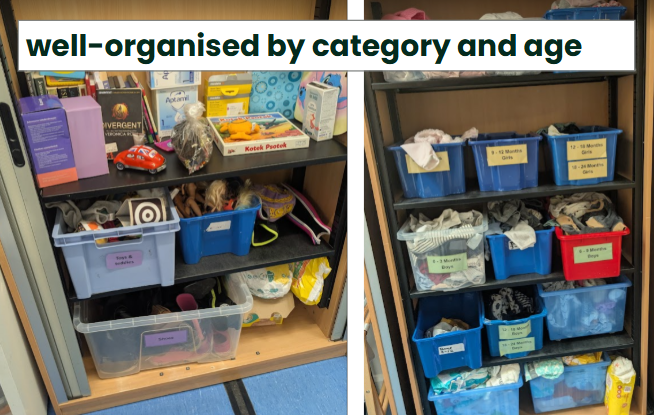
See below: A local “swap shop” from our time in South-East London:
Thanks to the research from Jonny Duguid and Kathryn Palmer-Skillings, and to the Neighbourly Lab team (especially Rebecca Nichols) and the Neya team (especially Grace McGrand).