
Notes from the Field: Community, Connection and the Scottish Way of Welcome in Renfrewshire
As part of the Welcome Coalition’s work mapping and evaluating welcome services and networks across the UK, our research team went to Renfrewshire, the second of our ethnographic deep-dive locations.
Across several days of visits and conversations, we explored how welcome is delivered in practice: who is involved, how organisations connect with one another, and how people new to an area navigate and move through these networks of support.
What quickly became clear was the breadth of actors involved in creating a local culture of welcome. From council teams and community centres to churches, grassroots organisations and volunteer-led initiatives, welcome is delivered through a wide network of people and places, each contributing something slightly different to the overall ecosystem.
Spaces of welcome in practice
One of the key entry points into this ecosystem is a health and wellbeing hub run by the local council’s Refugee Resettlement Team. Located close to a residential estate, the centre functions as a multi-purpose space where practical support sits alongside social and wellbeing activities.
Inside, the atmosphere is warm and welcoming. Staff greet visitors as they arrive, tea and coffee are available at reception, and different rooms host classes and sessions throughout the day. Practical support, such as housing advice, understanding rights, or help completing forms, is often the starting point. Over time, people are introduced to wider activities including ESOL classes, digital inclusion support and activity-based wellbeing groups.
Elsewhere, welcome takes shape in very different ways. At a local church, volunteers amongst the congregation have created a weekly gathering for young men seeking asylum. What began as informal football sessions organised by a local minister has gradually developed into a regular day of physical activity, conversation and connection.
The initiative grew naturally, from proximity, curiosity and openness: a local minister noticed that many of the young men living nearby were isolated and offered a place to spend time outside the hotel environment. Today, the sessions provide opportunities to connect with volunteers, access small donations of essentials and maintain friendships when people move on from hotel accommodation.
While modest in scale, the space plays an important role in addressing loneliness and providing dignity alongside practical help.
Community organisations shape belonging
Across Renfrewshire, a number of grassroots organisations are also creating spaces where cultural identity, community learning and integration intersect.
At a large community centre hosting several services, organisations such as Pachedu are building educational spaces that celebrate cultural heritage while gradually opening outward to the wider community. What began as a space focused on supporting a specific diaspora community is evolving into a multicultural hub designed to encourage interaction across different groups.
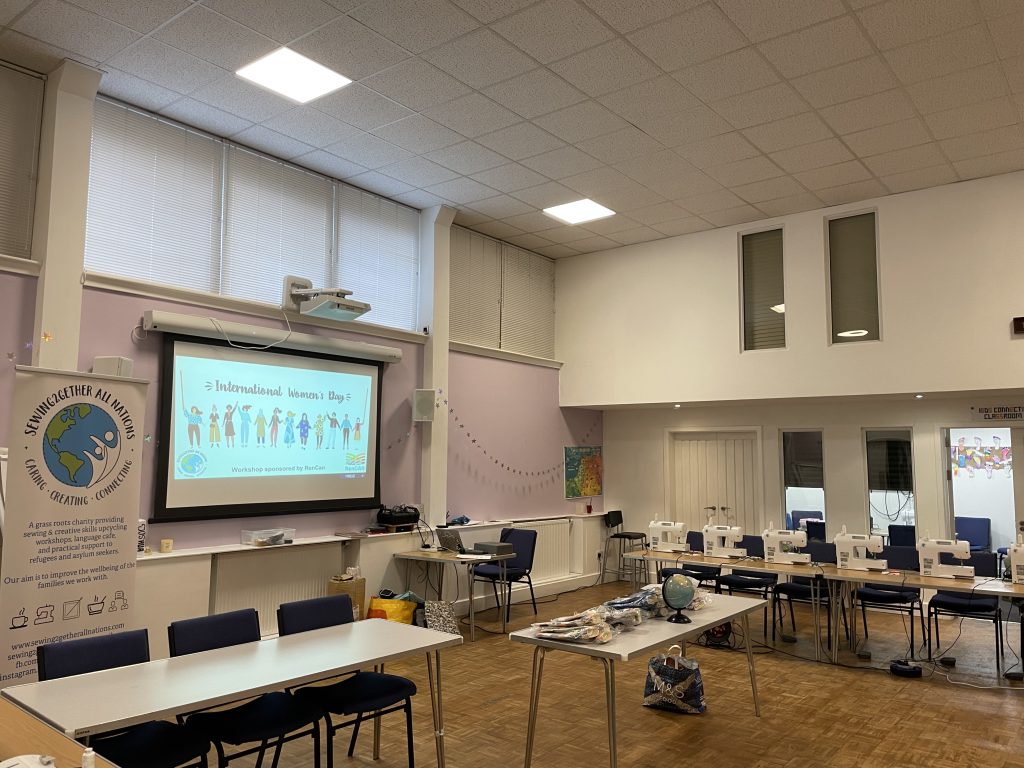
Other initiatives take an activity-based approach to connection. Sewing2getherAllNations brings together women from a range of backgrounds — Afghan, Ukrainian, African and Scottish — to sew together, with relationships forming through the shared act of making and learning.
t Kairos Women+, this approach has been extended through a programme where refugee and asylum-seeking women cook dishes from their cultures each week. For many participants living in asylum accommodation where cooking is not possible, the opportunity to prepare and share food becomes both empowering and a way of introducing others to their culture. Everyday activities can become powerful tools for connection, allowing relationships to form naturally rather than through formal services alone.
The ecosystem behind the work
Behind these individual initiatives sits a wider network, IN-Ren, connecting grassroots groups, larger organisations and public services to support newcomers. Through regular meetings, the network enables groups to share information, coordinate support for families and better understand the services available across the area.
For many organisations, this network plays an important role in strengthening relationships between services and ensuring that experiences from the ground can inform wider conversations about policy and practice.
At the same time, conversations during the fieldwork highlighted familiar challenges. Many organisations operate with limited funding and capacity, and there remain open questions about how best to support people to move from receiving support toward building independence and longer-term belonging in their communities.
Early reflections
Across the places we visited, a few initial themes began to emerge.
- Many of the organisations are committed to protecting their members’ sense of dignity and self-esteem which can be eroded by the migration or asylum process, expanding their focus beyond delivering essential items.
- Welcome is rarely delivered through a single service. Instead, it is experienced through a network of spaces and people – community hubs, churches, activity groups and volunteer initiatives – that people encounter at different moments in their journey.
- Shared activities often act as the bridge between groups. Whether through cooking, sewing, sport or shared meals, these everyday moments create opportunities for connection that formal services alone cannot easily replicate. Through their connection to this group, wider support can be made available and taken as and when it is needed.
Renfrewshire offers an important insight into how networks of welcome emerge in practice – shaped by local relationships, community initiative and the collective efforts of many different organisations working together.
If you are interested in learning more about this work or other projects we are doing as part of our Accelerating Welcome mission area, please reach out to beth@neighbourlylab.com.